
Setting Boundaries
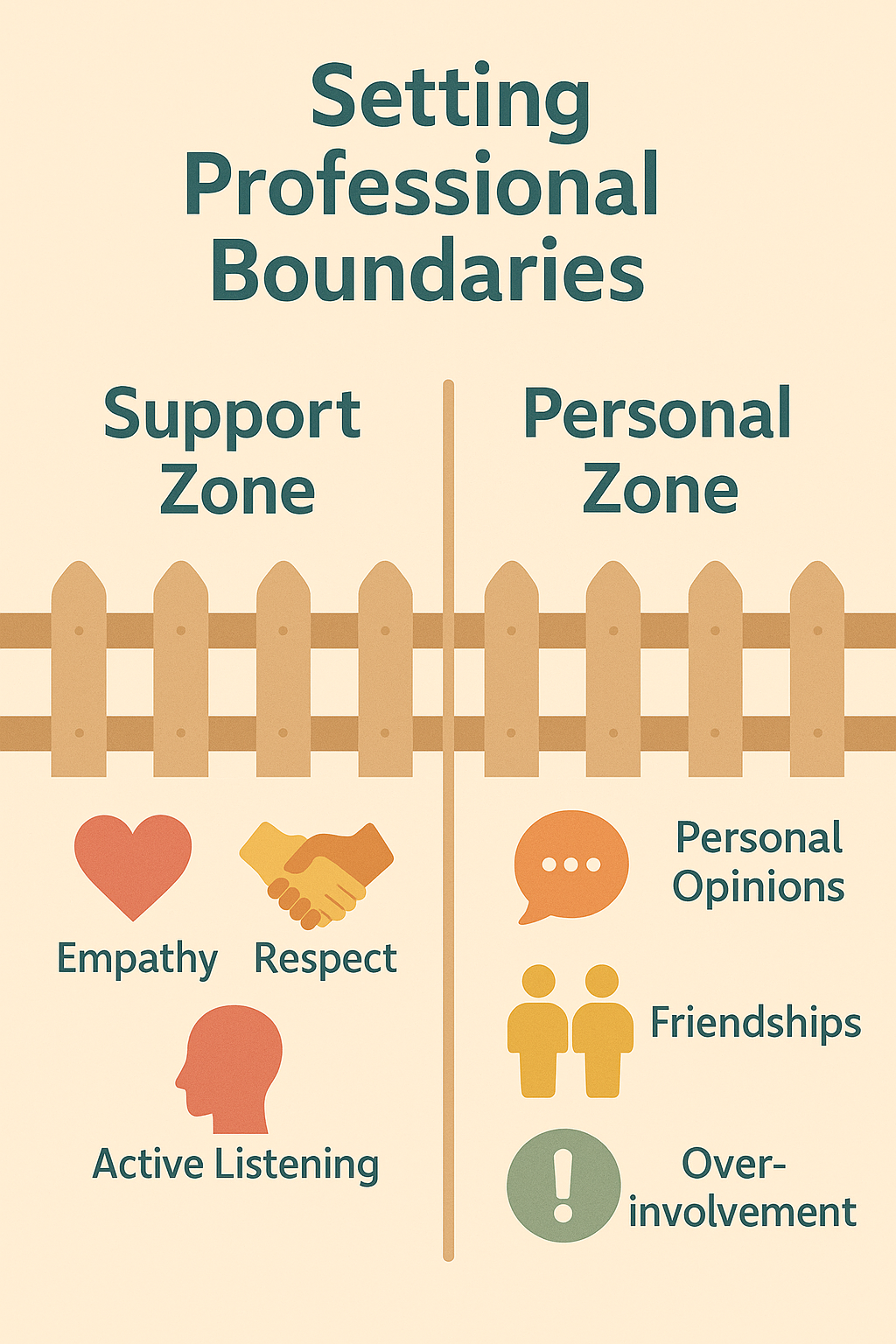
Setting boundaries is crucial for both the support worker and the individual receiving support. Boundaries help to:
– **Establish clear roles**: Define what is and what isn’t within your remit as a support worker.
– **Maintain professionalism**: While being empathetic, it’s important to keep the relationship professional.
– **Protect well-being**: Boundaries prevent burnout and ensure you can provide consistent support.
Communicating boundaries involves:
– **Being clear and consistent**: Explain the boundaries from the outset and stick to them.
– **Being assertive**: If a boundary is pushed, calmly restate it.
– **Offering alternatives**: If you can’t provide what is being asked for, suggest other resources or options.
Managing Challenging Conversations
Challenging conversations are a part of mental health support work. They may involve discussing distressing topics, addressing non-compliance with treatment, or setting boundaries. To manage these conversations:
– **Prepare**: If you anticipate a challenging conversation, prepare for it. Think about what you want to say and possible responses.
– **Stay calm**: Maintain a calm demeanor. If you feel your emotions rising, take a deep breath to regain composure.
– **Be clear**: Use simple language and be direct about the topic at hand.
– **Listen**: Give the individual time to express their thoughts and feelings.
– **Empathize**: Acknowledge the difficulty of the situation.
– **Collaborate on solutions**: Work together to find a way forward.
Crisis Communication
In a crisis, effective communication can be life-saving. It involves:
– **Staying calm**: Your calmness can help to de-escalate the situation.
– **Speaking softly but firmly**: This can be reassuring and help maintain a safe environment.
– **Listening to immediate concerns**: Address the most pressing issues first.
– **Ensuring safety**: Communicate any immediate actions needed to ensure the safety of all involved.
Documentation and Reporting
Accurate record-keeping is an essential part of communication in mental health support. Documentation should include:
– **Details of interactions**: Record dates, times, and content of conversations.
– **Observations**: Note behaviors, moods, and verbal and non-verbal cues.
– **Actions taken**: Document any steps you’ve taken or interventions made.
– **Confidentiality**: Maintain confidentiality in line with data protection laws (e.g., GDPR).
Cultural Sensitivity in Communication
Being culturally sensitive means being aware of and respecting the cultural differences of individuals. This includes:
– **Understanding cultural nuances**: Be aware of cultural norms and how they may affect communication.
– **Avoiding stereotypes**: Treat each individual as unique, not as a representative of a group.
– **Language considerations**: If an individual’s first language is not English, be mindful of potential language barriers.
Reflective Practice
Reflective practice is a method of self-evaluation that involves thinking about your communication and interactions. It helps to:
– **Identify strengths and areas for improvement**: Reflect on what worked well and what didn’t.
– **Learn from experiences**: Use each interaction as a learning opportunity.
– **Develop professional competency**: Continuously improve your communication skills.