
In addition to the strategies mentioned above, there are several advanced memory techniques that can further improve your ability to learn and retain information.
1. The Method of Loci: This ancient technique involves visualising a familiar place, such as your home, and mentally placing the items you want to remember along a path within this location. As you mentally walk through this space, you ‘see’ the items and can recall them more easily.
2. Peg System: The peg system is a mnemonic device where you associate information you want to remember with a pre-learned ‘peg’ list (such as numbers or letters associated with rhymes or images). When you need to recall the information, you think of the peg and the associated image or rhyme comes to mind, along with the information you attached to it.
3. Dual Coding: This approach involves combining verbal and visual information to enhance memory. For example, when learning a new concept, you could draw a diagram or create a mental image to go along with the verbal explanation. The combination of words and pictures is more potent than either one alone.
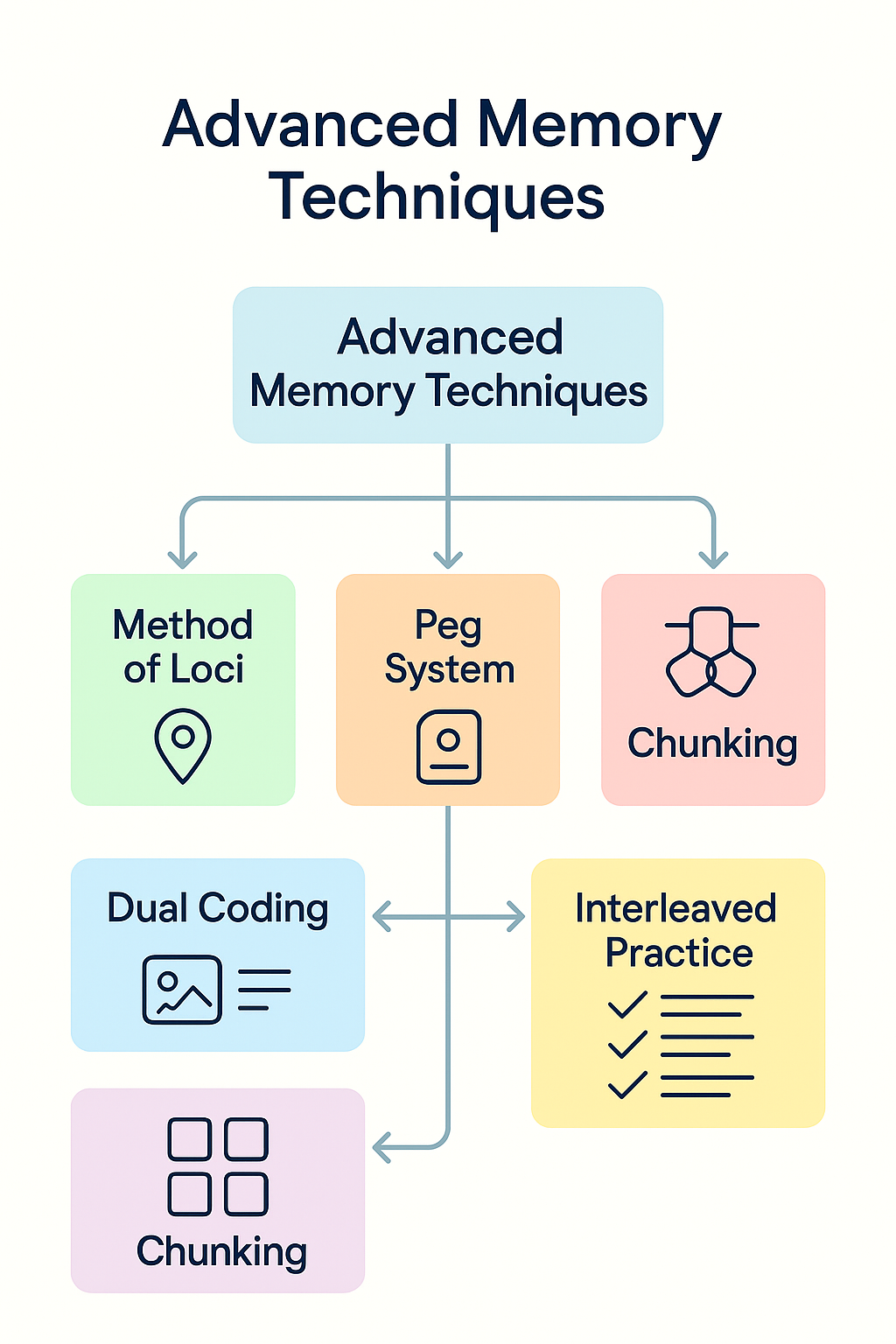
4. Chunking: Chunking involves breaking down large amounts of information into smaller, more manageable units (or ‘chunks’). This technique leverages the limited capacity of working memory by organising information into a format that is easier to process and remember.
5. Interleaved Practice: Unlike blocked practice, where you study one topic extensively before moving on to another, interleaved practice involves mixing different topics or types of problems within a single study session. This method can improve your ability to discriminate between concepts and apply the right method to the correct problem.