
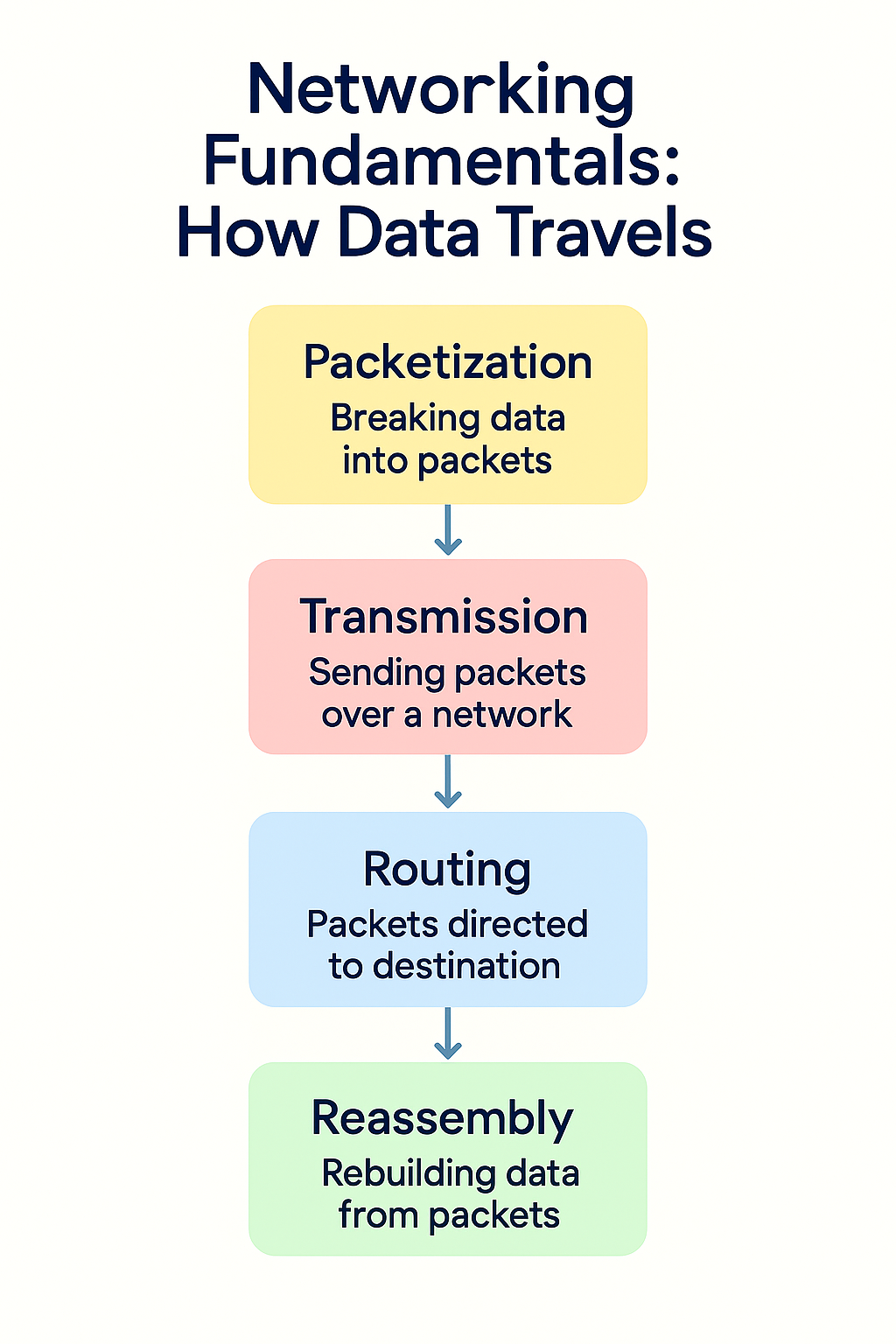
When you visit a website or send an email, the information is transmitted across the Internet in the form of data packets. Here’s a simplified breakdown of this journey:
Step 1: Packetisation
Your data, whether it’s a web page request or an email, is broken down into small pieces called packets. Each packet contains a portion of the data along with a header that holds important information like the destination IP (Internet Protocol) address.
Step 2: Transmission
The packets are sent out from your device to the local router and then onto the wider Internet. Along the way, they pass through multiple routers, each time being directed towards the destination.
Step 3: Routing
As packets move through the network, they may take different paths to reach their destination. This decentralised approach means the Internet can continue to operate even if parts of it are disrupted.
Step 4: Reassembly
Once packets arrive at their destination, they are reassembled into the original message. If any packets are missing or damaged, a request for retransmission is sent to the source.
Protocols: The Language of the Internet
For data to be transmitted accurately and efficiently, a set of rules or protocols must be followed. These protocols define how data is to be packetised, addressed, transmitted, routed, and received. Some of the key protocols include:
Transmission Control Protocol (TCP): TCP is responsible for ensuring that packets are delivered reliably. It takes care of packet sequencing and integrity, retransmitting any packets that are lost and assembling them in the correct order at the destination.
Internet Protocol (IP): IP is used for addressing and routing packets to their destination. Each device connected to the Internet has a unique IP address which ensures that the packets reach the right location.
Hypertext Transfer Protocol (HTTP) and HTTPS (HTTP Secure): These protocols are used for transferring web pages on the Internet. HTTPS includes encryption for secure communication.
Simple Mail Transfer Protocol (SMTP), Post Office Protocol (POP), and Internet Message Access Protocol (IMAP): These are used for email transmission and retrieval. SMTP is for sending emails, while POP and IMAP are for receiving.