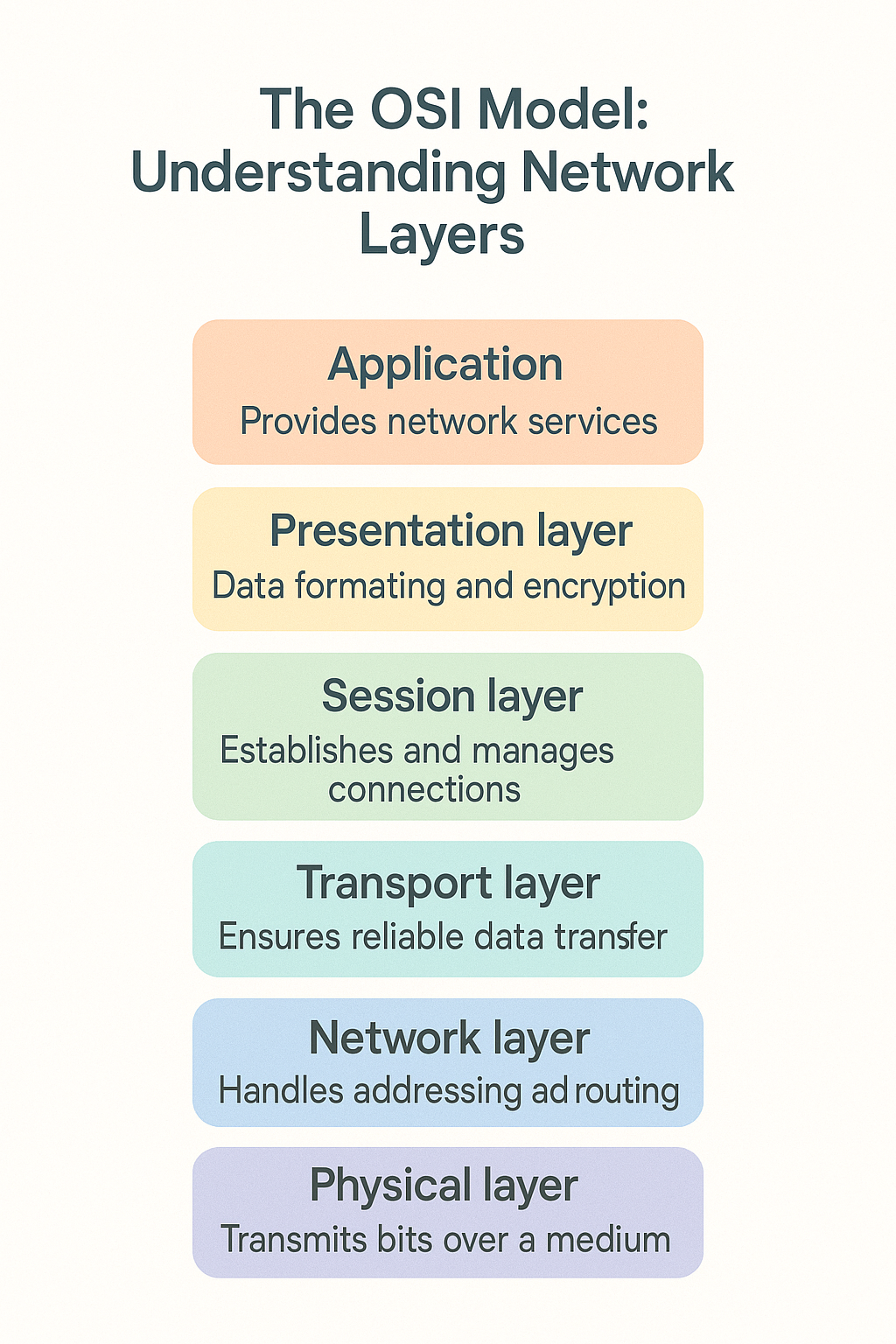
The OSI model is a conceptual framework used to understand the complex interactions that occur in network communications. It divides network communication into seven layers, each serving a specific function:
1. Physical Layer: This is the foundational level where hardware (cables, switches, and the electrical signals or wireless transmissions) exists. It is responsible for the transmission and reception of unstructured raw data over a physical medium.
2. Data Link Layer: Here, data packets are encoded and decoded into bits. It also handles error checking and frame synchronisation. This layer is where the Media Access Control (MAC) address operates, which is unique to each device.
3. Network Layer: This layer is concerned with data packet forwarding, including routing through intermediate routers. It is where the Internet Protocol (IP) operates, enabling connectivity and path determination.
4. Transport Layer: Responsible for end-to-end communication and data flow control, the Transport Layer ensures the complete data transfer with protocols like TCP and User Datagram Protocol (UDP).
5. Session Layer: This layer manages sessions with the ability to set up, coordinate, and terminate conversations and data exchanges.
6. Presentation Layer: It translates data between the network and application layers, ensuring that the data is delivered in a readable format.
7. Application Layer: The interface with the end-user, this layer is where communication partners are identified, quality of service is identified, user authentication and privacy are considered, and any constraints on data syntax are identified. Protocols like HTTP, FTP, SMTP operate at this level.