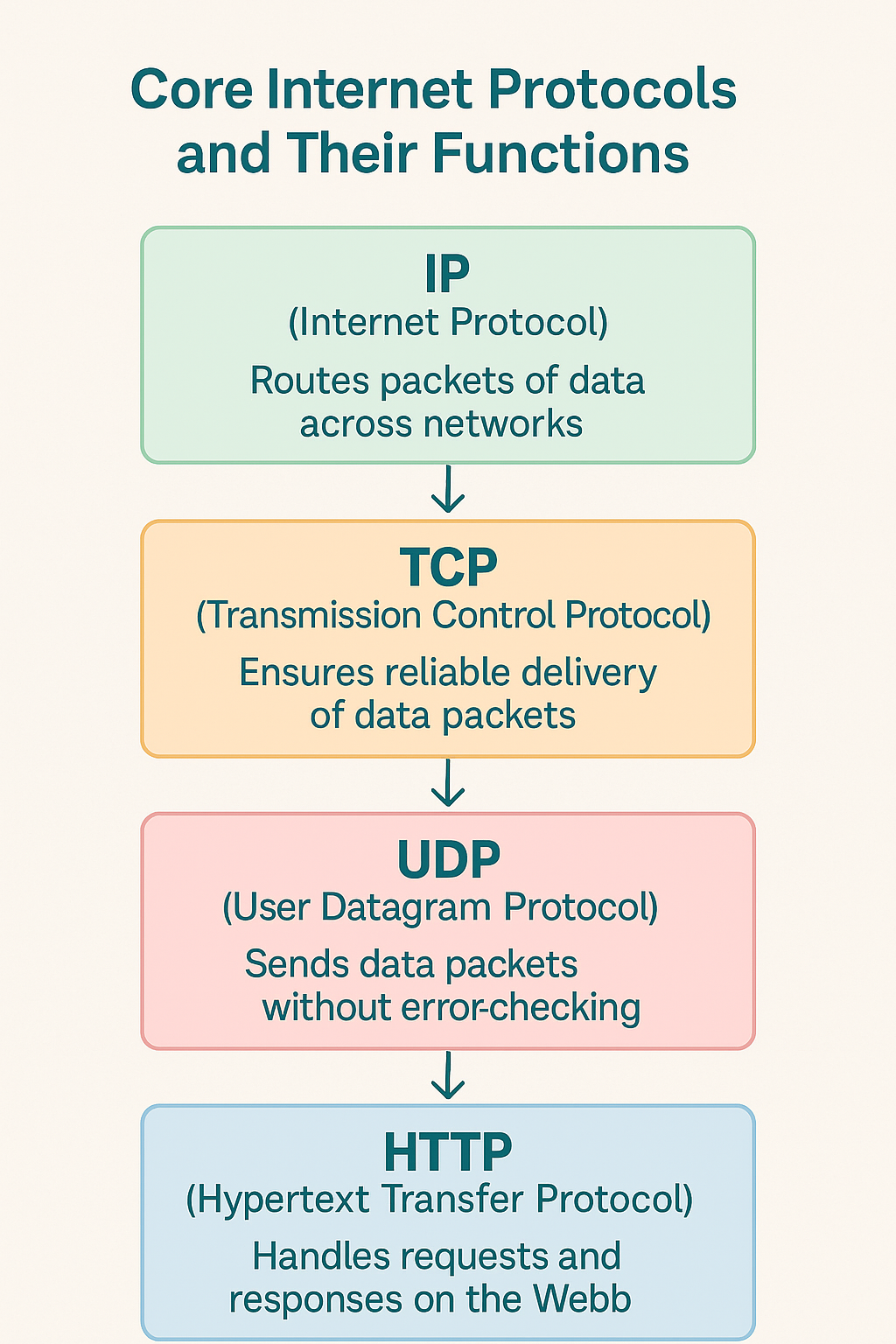
The Internet operates more practically on a simpler model called the Internet Protocol Suite, commonly known as the TCP/IP model. It condenses the layers of the OSI model into four layers:
1. Link Layer: Combining the Physical and Data Link layers of the OSI model, the Link Layer is where network hardware and protocols ensure that data can be transmitted over the physical network.
2. Internet Layer: This corresponds to the Network Layer of the OSI model, where the IP operates to route packets across networks.
3. Transport Layer: Like the OSI model, the Transport Layer is where TCP and UDP operate to ensure data is transferred reliably from point to point.
4. Application Layer: This merges the Session, Presentation, and Application layers of the OSI model. Protocols like HTTP, SMTP, FTP, and DNS work here to provide various services to applications.
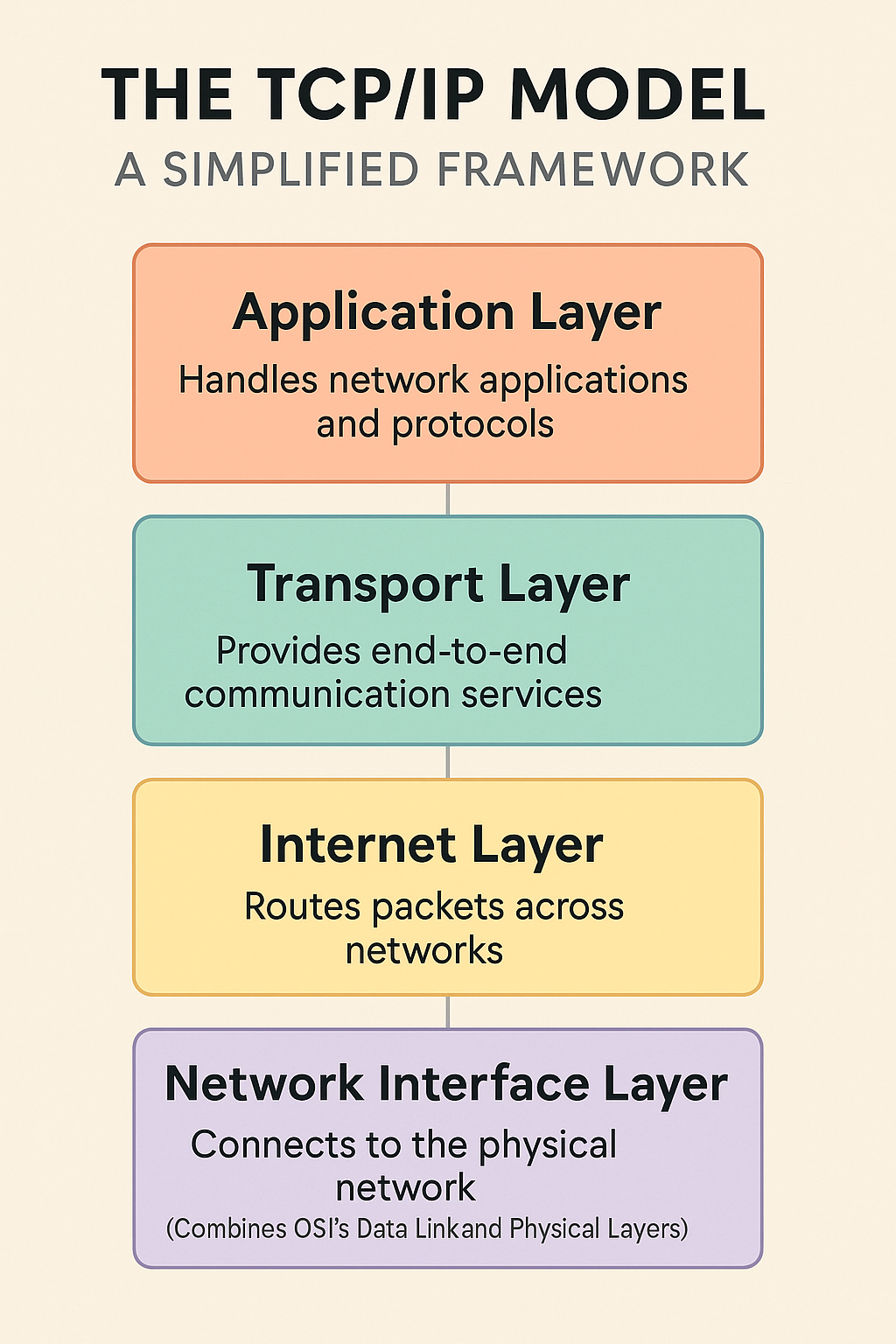
Core Protocols and Their Functions
Understanding the core protocols that operate within these layers is critical to comprehending how the Internet functions.
Internet Protocol (IP)
IP is responsible for delivering packets from the source host to the destination host based solely on the IP addresses in the packet headers. IP is a connectionless protocol, meaning there is no continuous connection between the end points that are communicating.
Transmission Control Protocol (TCP)
TCP is a connection-oriented protocol, meaning a connection is established and maintained until the application programs at each end have finished exchanging messages. It ensures that data is delivered in the order it was sent and that no packets have gone missing or contain errors.
User Datagram Protocol (UDP)
UDP is a simpler, connectionless Internet protocol. It does not guarantee message delivery and does not ensure proper sequencing or avoidance of duplicate delivery. These aspects are up to the application layer to manage. This protocol is used when speed is desirable and error correction is not necessary, such as streaming audio or video.
Hypertext Transfer Protocol (HTTP) and HTTPS
HTTP is the protocol used for transferring web pages on the Internet. When secured with Transport Layer Security (TLS), it becomes HTTPS, where ‘S’ stands for ‘secure’. HTTPS ensures that communications between the browser and the website are encrypted and secure.
File Transfer Protocol (FTP)
FTP is used to transfer computer files between a client and server on a computer network. It offers mechanisms for user authentication and is built on a client-server model architecture.
Simple Mail Transfer Protocol (SMTP) and Post Office Protocol (POP)/Internet Message Access Protocol (IMAP)
SMTP is the protocol for sending email messages between servers. Most email systems use SMTP to send messages from one server to another. For retrieving messages, email systems use either POP or IMAP. POP downloads emails from a server for permanent local storage, while IMAP allows remote access to and management of emails stored on the server.
Domain Name System (DNS)
DNS is a hierarchical and decentralised naming system for computers, services, or any resource connected to the Internet. It associates various information with domain names assigned to each of the participants. Most importantly, it translates human-readable domain names to machine-readable IP addresses.